Design a refined, high-end rotating ring based on the established concept. The design must be minimal, cohesive, wearable, physically plausible, and suitable for real fine-jewelry manufacturing.

Core structure

Create a ring with a fixed inner ring and a rotating outer ring. The outer ring rotates 360 degrees around the fixed inner ring.

The ring band must maintain a completely consistent width and thickness around the entire circumference. Do not make any section wider, narrower, thicker, thinner, or bulky.

The rotating outer ring must have a very subtle approximately 3-degree helical twist along its circumference. The twist should be extremely gentle and refined, creating a slight spiral orientation that makes the outer ring easier and more natural to rotate by hand.

The 3-degree twist must NOT distort the ring into a warped or uneven shape. The band width and thickness must remain constant. The outer edge should remain smooth, continuous, and comfortable against the skin.

The twist should be subtle enough to look like a sophisticated fine-jewelry detail rather than a dramatic spiral ring.

Low-profile and wearable construction

All decorative elements must sit very close to or partially within the surface of the ring.

Minimize all raised, protruding, sharp, or exposed elements.

The ring should have a smooth outer silhouette so that it does not easily scratch the wearer or catch on clothing.

Avoid large three-dimensional structures, floating objects, exposed wires, complicated orbital structures, or anything that sticks significantly above the ring surface.

The overall design should feel sleek, smooth, compact, and wearable every day.

Cosmic aesthetic

The ring should strongly evoke deep space and the night sky, but without filling the ring with excessive objects.

The feeling of space should come primarily from the surface treatment, engraving, texture, and composition, rather than numerous three-dimensional decorations.

Use subtle celestial details such as:

* very small scattered stars
* tiny points of light
* subtle lunar texture
* faint deep-space texture
* small areas of dark oxidized metal
* sparse micro-engraving resembling distant stars

Do NOT use continuous orbital lines, wires, large planetary objects, multiple moons, or excessive stars.

The cosmic atmosphere should feel deep, quiet, mysterious, and elegant, like looking into a dark night sky.

The ring should suggest the universe without literally depicting a miniature solar system.

Moon

Use one small moon as a refined focal detail.

The moon should be smaller than in the previous designs and integrated closely into the rotating outer ring.

It should have subtle realistic lunar surface texture but remain low-profile.

The moon should not dominate the entire ring.

It should feel like a small celestial body naturally embedded within the larger cosmic composition.

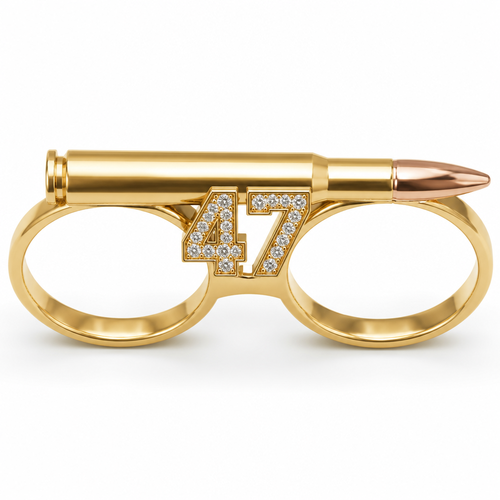
Bullet

Include one simple, recognizable bullet-shaped element.

The bullet must have a clean and unmistakable silhouette: a smooth cylindrical body with a simple rounded or gently pointed nose.

Absolutely no decorative lines, grooves, wires, orbit lines, segmentation, insect-like details, legs, antenna-like shapes, or complex surface patterns.

The bullet should look like a refined solid-metal bullet form, not an insect and not an abstract creature.

Keep it low-profile and partially integrated into the surface of the rotating ring.

Feather

Include one slim and elegant feather motif.

The feather should be simplified and partially engraved or embedded into the surface rather than being a large raised three-dimensional feather.

It should follow the curvature of the ring and remain close to the surface.

The feather should feel like a subtle symbol rather than a separate sculpture attached to the ring.

Gemini constellation

The Gemini constellation must NOT appear anywhere on the exterior of the ring.

Do not use the Gemini zodiac symbol “♊”.

Instead, engrave the actual Gemini constellation pattern using individual stars and the recognizable arrangement of the Gemini constellation on the inside surface of the fixed inner ring.

The Gemini constellation should be a subtle fine engraving.

It does not need to be positioned at the exact center of the inner ring. It can be slightly offset along the inner circumference.

The constellation should only become visible when the inside of the ring is intentionally viewed.

Exterior design

The exterior should remain visually clean.

The moon, bullet, feather, and sparse celestial details should be integrated into a single coherent composition.

Do not allow the decorative elements to overflow or crowd the surface.

Maintain generous negative space.

The 3-degree helical twist of the outer edge should provide the main sense of movement, while the subtle celestial details provide the cosmic atmosphere.

Consistency between views

This is extremely important:

Every view must depict the exact same physical ring design.

The front view, side view, inner view, three-quarter view, rotating view, close-ups, and developed view must all show identical proportions, identical decorative placement, identical band width, identical band thickness, and identical construction.

Do not redesign or reinterpret the ring between views.

The side view is the primary silhouette reference. Preserve its low-profile shape and proportions consistently in every other view.

Developed / unrolled view

Include a technical developed view of the ring.

This is NOT a conventional cross-section or cutaway.

Show the ring as if the circular ring band has been cut at exactly one point and then physically unrolled flat into a straight strip, allowing the entire circumference to be viewed from the opposite side.

Show the continuous exterior surface from one end to the other.

This developed view should reveal the parts of the exterior that cannot be seen from the normal curved perspective.

Show the subtle 3-degree helical twist across the developed outer-ring strip.

Also show the fixed inner ring as a separate developed strip where appropriate.

Clearly indicate the single cut/opening point.

The developed strip must preserve the exact same constant width and thickness as the actual ring.

Rotation mechanism

Show the rotating outer ring and fixed inner ring as two separate components.

The rotating mechanism should be concealed within the ring construction.

Do not show bulky bearings, screws, hinges, wires, or exposed mechanical hardware.

The ring should visually appear elegant and seamless when assembled.

Materials

Polished sterling silver or white gold.

Subtle dark oxidized recessed areas may be used to create depth and reinforce the feeling of deep space.

Optional extremely small gemstone points may represent distant stars.

Avoid excessive gemstones.

Overall aesthetic

Luxury fine jewelry.

Minimalist celestial design.

Dark, mysterious, elegant, sophisticated.

Deep-space atmosphere rather than a literal miniature solar system.

Low-profile construction.

Smooth wearable surfaces.

No bulky ornamentation.

No fantasy armor aesthetic.

No steampunk aesthetic.

No insect-like bullet.

No excessive orbital structures.

No exposed wires.

No sharp protrusions.

No elements that can easily snag on clothing.

Presentation

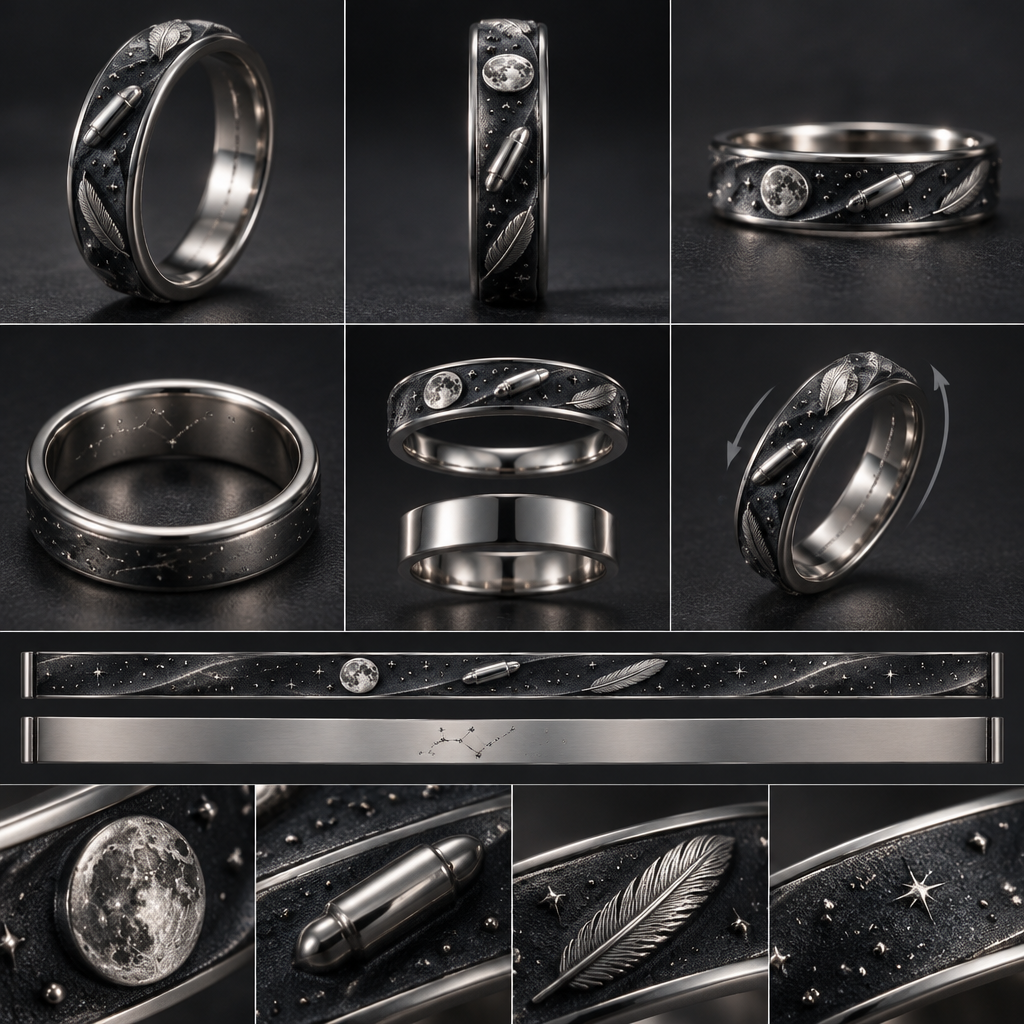
Create a professional jewelry design presentation showing:

1. Hero three-quarter view
2. Exact side view matching the hero design
3. Front view
4. Inner view showing the Gemini constellation engraving
5. Rotating outer-ring mechanism
6. Developed / unrolled view after cutting the ring at one point
7. Close-up of the moon
8. Close-up of the bullet
9. Close-up of the feather
10. Close-up of the subtle cosmic surface treatment

All views must represent one single identical ring design.

Photorealistic fine-jewelry rendering, realistic manufacturing proportions, precise metalwork, smooth polished surfaces, subtle engraving, controlled studio lighting, realistic scale, premium jewelry photography.

Prioritize wearability, low profile, constant band width, subtle 3-degree helical twist, cosmic atmosphere, structural coherence, and simplicity over excessive visual detail.

photorealistic jewelry design, Design a refined, high-end rotating ring based on the established concept. The design must be minimal, cohesive, wearable, physically plausible, and suitable for real fine-jewelry manufacturing.

Core structure

Create a ring with a fixed inner ring and a rotating outer ring. The outer ring rotates 360 degrees around the fixed inner ring.

The ring band must maintain a completely consistent width and thickness around the entire circumference. Do not make any section wider, narrower, thicker, thinner, or bulky.

The rotating outer ring must have a very subtle approximately 3-degree helical twist along its circumference. The twist should be extremely gentle and refined, creating a slight spiral orientation that makes the outer ring easier and more natural to rotate by hand.

The 3-degree twist must NOT distort the ring into a warped or uneven shape. The band width and thickness must remain constant. The outer edge should remain smooth, continuous, and comfortable against the skin.

The twist should be subtle enough to look like a sophisticated fine-jewelry detail rather than a dramatic spiral ring.

Low-profile and wearable construction

All decorative elements must sit very close to or partially within the surface of the ring.

Minimize all raised, protruding, sharp, or exposed elements.

The ring should have a smooth outer silhouette so that it does not easily scratch the wearer or catch on clothing.

Avoid large three-dimensional structures, floating objects, exposed wires, complicated orbital structures, or anything that sticks significantly above the ring surface.

The overall design should feel sleek, smooth, compact, and wearable every day.

Cosmic aesthetic

The ring should strongly evoke deep space and the night sky, but without filling the ring with excessive objects.

The feeling of space should come primarily from the surface treatment, engraving, texture, and composition, rather than numerous three-dimensional decorations.

Use subtle celestial details such as:

* very small scattered stars
* tiny points of light
* subtle lunar texture
* faint deep-space texture
* small areas of dark oxidized metal
* sparse micro-engraving resembling distant stars

Do NOT use continuous orbital lines, wires, large planetary objects, multiple moons, or excessive stars.

The cosmic atmosphere should feel deep, quiet, mysterious, and elegant, like looking into a dark night sky.

The ring should suggest the universe without literally depicting a miniature solar system.

Moon

Use one small moon as a refined focal detail.

The moon should be smaller than in the previous designs and integrated closely into the rotating outer ring.

It should have subtle realistic lunar surface texture but remain low-profile.

The moon should not dominate the entire ring.

It should feel like a small celestial body naturally embedded within the larger cosmic composition.

Bullet

Include one simple, recognizable bullet-shaped element.

The bullet must have a clean and unmistakable silhouette: a smooth cylindrical body with a simple rounded or gently pointed nose.

Absolutely no decorative lines, grooves, wires, orbit lines, segmentation, insect-like details, legs, antenna-like shapes, or complex surface patterns.

The bullet should look like a refined solid-metal bullet form, not an insect and not an abstract creature.

Keep it low-profile and partially integrated into the surface of the rotating ring.

Feather

Include one slim and elegant feather motif.

The feather should be simplified and partially engraved or embedded into the surface rather than being a large raised three-dimensional feather.

It should follow the curvature of the ring and remain close to the surface.

The feather should feel like a subtle symbol rather than a separate sculpture attached to the ring.

Gemini constellation

The Gemini constellation must NOT appear anywhere on the exterior of the ring.

Do not use the Gemini zodiac symbol “♊”.

Instead, engrave the actual Gemini constellation pattern using individual stars and the recognizable arrangement of the Gemini constellation on the inside surface of the fixed inner ring.

The Gemini constellation should be a subtle fine engraving.

It does not need to be positioned at the exact center of the inner ring. It can be slightly offset along the inner circumference.

The constellation should only become visible when the inside of the ring is intentionally viewed.

Exterior design

The exterior should remain visually clean.

The moon, bullet, feather, and sparse celestial details should be integrated into a single coherent composition.

Do not allow the decorative elements to overflow or crowd the surface.

Maintain generous negative space.

The 3-degree helical twist of the outer edge should provide the main sense of movement, while the subtle celestial details provide the cosmic atmosphere.

Consistency between views

This is extremely important:

Every view must depict the exact same physical ring design.

The front view, side view, inner view, three-quarter view, rotating view, close-ups, and developed view must all show identical proportions, identical decorative placement, identical band width, identical band thickness, and identical construction.

Do not redesign or reinterpret the ring between views.

The side view is the primary silhouette reference. Preserve its low-profile shape and proportions consistently in every other view.

Developed / unrolled view

Include a technical developed view of the ring.

This is NOT a conventional cross-section or cutaway.

Show the ring as if the circular ring band has been cut at exactly one point and then physically unrolled flat into a straight strip, allowing the entire circumference to be viewed from the opposite side.

Show the continuous exterior surface from one end to the other.

This developed view should reveal the parts of the exterior that cannot be seen from the normal curved perspective.

Show the subtle 3-degree helical twist across the developed outer-ring strip.

Also show the fixed inner ring as a separate developed strip where appropriate.

Clearly indicate the single cut/opening point.

The developed strip must preserve the exact same constant width and thickness as the actual ring.

Rotation mechanism

Show the rotating outer ring and fixed inner ring as two separate components.

The rotating mechanism should be concealed within the ring construction.

Do not show bulky bearings, screws, hinges, wires, or exposed mechanical hardware.

The ring should visually appear elegant and seamless when assembled.

Materials

Polished sterling silver or white gold.

Subtle dark oxidized recessed areas may be used to create depth and reinforce the feeling of deep space.

Optional extremely small gemstone points may represent distant stars.

Avoid excessive gemstones.

Overall aesthetic

Luxury fine jewelry.

Minimalist celestial design.

Dark, mysterious, elegant, sophisticated.

Deep-space atmosphere rather than a literal miniature solar system.

Low-profile construction.

Smooth wearable surfaces.

No bulky ornamentation.

No fantasy armor aesthetic.

No steampunk aesthetic.

No insect-like bullet.

No excessive orbital structures.

No exposed wires.

No sharp protrusions.

No elements that can easily snag on clothing.

Presentation

Create a professional jewelry design presentation showing:

1. Hero three-quarter view
2. Exact side view matching the hero design
3. Front view
4. Inner view showing the Gemini constellation engraving
5. Rotating outer-ring mechanism
6. Developed / unrolled view after cutting the ring at one point
7. Close-up of the moon
8. Close-up of the bullet
9. Close-up of the feather
10. Close-up of the subtle cosmic surface treatment

All views must represent one single identical ring design.

Photorealistic fine-jewelry rendering, realistic manufacturing proportions, precise metalwork, smooth polished surfaces, subtle engraving, controlled studio lighting, realistic scale, premium jewelry photography.

Prioritize wearability, low profile, constant band width, subtle 3-degree helical twist, cosmic atmosphere, structural coherence, and simplicity over excessive visual detail., just the design no text

Design a refined, high-end rotating ring based on the established concept. The design must be minimal, cohesive, wearable, physically plausible, and suitable for real fine-jewelry manufacturing. Core structure Create a ring with a fixed inner ring and a rotating outer ring. The outer ring rotates 360 degrees around the fixed inner ring. The ring band must maintain a completely consistent width and thickness around the entire circumference. Do not make any section wider, narrower, thicker, thinner, or bulky. The rotating outer ring must have a very subtle approximately 3-degree helical twist along its circumference. The twist should be extremely gentle and refined, creating a slight spiral orientation that makes the outer ring easier and more natural to rotate by hand. The 3-degree twist must NOT distort the ring into a warped or uneven shape. The band width and thickness must remain constant. The outer edge should remain smooth, continuous, and comfortable against the skin. The twist should be subtle enough to look like a sophisticated fine-jewelry detail rather than a dramatic spiral ring. Low-profile and wearable construction All decorative elements must sit very close to or partially within the surface of the ring. Minimize all raised, protruding, sharp, or exposed elements. The ring should have a smooth outer silhouette so that it does not easily scratch the wearer or catch on clothing. Avoid large three-dimensional structures, floating objects, exposed wires, complicated orbital structures, or anything that sticks significantly above the ring surface. The overall design should feel sleek, smooth, compact, and wearable every day. Cosmic aesthetic The ring should strongly evoke deep space and the night sky, but without filling the ring with excessive objects. The feeling of space should come primarily from the surface treatment, engraving, texture, and composition, rather than numerous three-dimensional decorations. Use subtle celestial details such as: * very small scattered stars * tiny points of light * subtle lunar texture * faint deep-space texture * small areas of dark oxidized metal * sparse micro-engraving resembling distant stars Do NOT use continuous orbital lines, wires, large planetary objects, multiple moons, or excessive stars. The cosmic atmosphere should feel deep, quiet, mysterious, and elegant, like looking into a dark night sky. The ring should suggest the universe without literally depicting a miniature solar system. Moon Use one small moon as a refined focal detail. The moon should be smaller than in the previous designs and integrated closely into the rotating outer ring. It should have subtle realistic lunar surface texture but remain low-profile. The moon should not dominate the entire ring. It should feel like a small celestial body naturally embedded within the larger cosmic composition. Bullet Include one simple, recognizable bullet-shaped element. The bullet must have a clean and unmistakable silhouette: a smooth cylindrical body with a simple rounded or gently pointed nose. Absolutely no decorative lines, grooves, wires, orbit lines, segmentation, insect-like details, legs, antenna-like shapes, or complex surface patterns. The bullet should look like a refined solid-metal bullet form, not an insect and not an abstract creature. Keep it low-profile and partially integrated into the surface of the rotating ring. Feather Include one slim and elegant feather motif. The feather should be simplified and partially engraved or embedded into the surface rather than being a large raised three-dimensional feather. It should follow the curvature of the ring and remain close to the surface. The feather should feel like a subtle symbol rather than a separate sculpture attached to the ring. Gemini constellation The Gemini constellation must NOT appear anywhere on the exterior of the ring. Do not use the Gemini zodiac symbol “♊”. Instead, engrave the actual Gemini constellation pattern using individual stars and the recognizable arrangement of the Gemini constellation on the inside surface of the fixed inner ring. The Gemini constellation should be a subtle fine engraving. It does not need to be positioned at the exact center of the inner ring. It can be slightly offset along the inner circumference. The constellation should only become visible when the inside of the ring is intentionally viewed. Exterior design The exterior should remain visually clean. The moon, bullet, feather, and sparse celestial details should be integrated into a single coherent composition. Do not allow the decorative elements to overflow or crowd the surface. Maintain generous negative space. The 3-degree helical twist of the outer edge should provide the main sense of movement, while the subtle celestial details provide the cosmic atmosphere. Consistency between views This is extremely important: Every view must depict the exact same physical ring design. The front view, side view, inner view, three-quarter view, rotating view, close-ups, and developed view must all show identical proportions, identical decorative placement, identical band width, identical band thickness, and identical construction. Do not redesign or reinterpret the ring between views. The side view is the primary silhouette reference. Preserve its low-profile shape and proportions consistently in every other view. Developed / unrolled view Include a technical developed view of the ring. This is NOT a conventional cross-section or cutaway. Show the ring as if the circular ring band has been cut at exactly one point and then physically unrolled flat into a straight strip, allowing the entire circumference to be viewed from the opposite side. Show the continuous exterior surface from one end to the other. This developed view should reveal the parts of the exterior that cannot be seen from the normal curved perspective. Show the subtle 3-degree helical twist across the developed outer-ring strip. Also show the fixed inner ring as a separate developed strip where appropriate. Clearly indicate the single cut/opening point. The developed strip must preserve the exact same constant width and thickness as the actual ring. Rotation mechanism Show the rotating outer ring and fixed inner ring as two separate components. The rotating mechanism should be concealed within the ring construction. Do not show bulky bearings, screws, hinges, wires, or exposed mechanical hardware. The ring should visually appear elegant and seamless when assembled. Materials Polished sterling silver or white gold. Subtle dark oxidized recessed areas may be used to create depth and reinforce the feeling of deep space. Optional extremely small gemstone points may represent distant stars. Avoid excessive gemstones. Overall aesthetic Luxury fine jewelry. Minimalist celestial design. Dark, mysterious, elegant, sophisticated. Deep-space atmosphere rather than a literal miniature solar system. Low-profile construction. Smooth wearable surfaces. No bulky ornamentation. No fantasy armor aesthetic. No steampunk aesthetic. No insect-like bullet. No excessive orbital structures. No exposed wires. No sharp protrusions. No elements that can easily snag on clothing. Presentation Create a professional jewelry design presentation showing: 1. Hero three-quarter view 2. Exact side view matching the hero design 3. Front view 4. Inner view showing the Gemini constellation engraving 5. Rotating outer-ring mechanism 6. Developed / unrolled view after cutting the ring at one point 7. Close-up of the moon 8. Close-up of the bullet 9. Close-up of the feather 10. Close-up of the subtle cosmic surface treatment All views must represent one single identical ring design. Photorealistic fine-jewelry rendering, realistic manufacturing proportions, precise metalwork, smooth polished surfaces, subtle engraving, controlled studio lighting, realistic scale, premium jewelry photography. Prioritize wearability, low profile, constant band width, subtle 3-degree helical twist, cosmic atmosphere, structural coherence, and simplicity over excessive visual detail.

Keep exploring

More None