Create 10 additional luxury earring concepts using the same signature design language, but do not repeat any of the previous silhouettes.

Target finished weight: approximately 3.0 grams per pair in 18K gold. All designs must remain lightweight, refined, manufacturable, comfortable and suitable for premium fine-jewellery production.

Mandatory design DNA for every concept:
Use multiple slender parallel polished-gold bars, arranged in a graduated sequence so that each bar progressively changes in length. This must create a clearly visible stepped, tapering rhythm. Incorporate a controlled micro-pavé diamond section close to the earlobe, concentrating brilliance near the face while allowing the gold-bar structure to remain the hero.

Create the following 10 completely new silhouettes:

11. Spiral Cascade
Arrange the graduated bars along a subtle spiral trajectory beginning from a compact pavé curve near the ear. The bars should progressively lengthen while appearing to rotate gently downward, giving a sophisticated sense of movement without creating a literal spiral.

12. Arrow Sweep
Organize the parallel graduated bars into a sleek directional arrow-like silhouette. Create a sharp but elegant diagonal progression, with a slim pavé accent defining the upper leading edge. Keep the design abstract rather than using a literal arrow shape.

13. Floating Bridge
Create two slim structural points connected visually by graduated bars across an open negative-space area. The bars should transition from short to long and back toward short, producing an architectural bridge-like profile with pavé concentrated near the ear.

14. Side Comet
Start with a compact pavé diamond head near the earlobe and allow the graduated bars to trail diagonally backward like an abstract comet tail. Use progressively longer bars through the center before tapering again toward the edge.

15. Folded Fan
Interpret the parallel bars as a partially folded fan rather than a fully open fan. Keep one side compressed and gradually expand the bar lengths toward one directional edge, creating an elegant asymmetric triangular profile.

16. Architectural Arch
Arrange the tops of the bars along a subtle arch while their lower ends create a strong graduated staircase. Integrate a fine pavé arc into one side of the upper structure. The result should feel architectural, clean and contemporary.

17. Offset Chevron
Use two staggered groups of parallel graduated bars that meet visually in an off-center chevron formation. One side should be slightly longer and more dominant. Place the pavé only along the shorter upper section to maintain lightness.

18. Slim Flame
Shape the overall silhouette into an abstract rising flame using angled graduated bars. The longest bar should form the central visual direction, while surrounding bars progressively shorten. Add a slender pavé line following one upper contour.

19. Draped Curve
Create the illusion that the parallel bars are suspended from a gently drooping curved pavé line. Each bar should remain straight, but their starting positions and graduated lengths should create a soft draped or suspended architectural effect.

20. Split Cascade
Begin with one small pavé element close to the earlobe, then divide the graduated-bar motif into two narrow directional cascades separated by fine negative space. One cascade should be shorter and more compact, while the second becomes longer and more dramatic.

Luxury design direction:
Contemporary haute joaillerie, sophisticated architectural geometry, feminine but not floral, refined asymmetry, elegant negative space, extremely precise bar spacing, polished 18K gold surfaces, delicate micro-pavé diamonds, clean transitions and premium craftsmanship.

Weight constraint:
Engineer visually for a maximum target of approximately 3 grams for the complete pair. Use very fine bar profiles, strategic open spaces, minimal pavé area, thin connecting structures and hollow/lightweight engineering where practical. Avoid excessive solid gold mass.

The earrings should appear substantial and luxurious from the front while remaining physically lightweight.

Important design requirement:
All 10 concepts must look like members of the same jewellery collection, but each must have a clearly different overall silhouette, center of gravity, directional movement and negative-space composition.

Do not simply reposition identical bars. Change the structural flow and outer contour of every concept while preserving the recognizable graduated-bar signature.

Presentation:
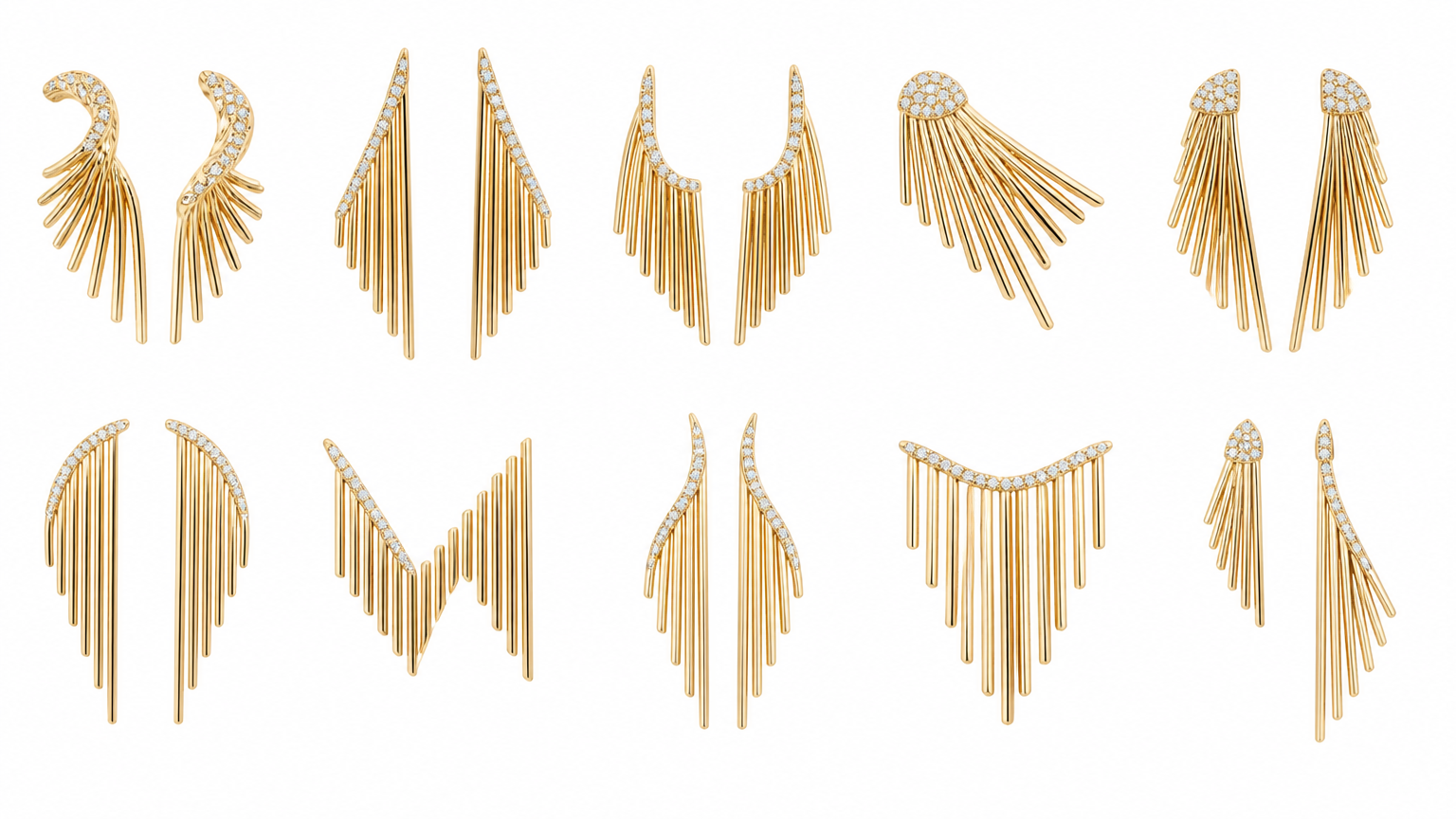
Show all 10 concepts on one professional jewellery-development sheet, numbered 11–20, front view, identical scale, isolated on a pure white background, no model, no hands, no decorative objects, highly realistic 18K gold and diamond rendering, crisp jewellery photography quality, suitable for selection before CAD development.

Avoid: literal feathers, literal wings, flowers, leaves, hearts, stars, butterflies, tassel chains, conventional chandelier earrings, simple straight fringes, oversized diamonds, thick bars, bulky cast forms, excessive pavé, repeated silhouettes and concepts that differ only by changing bar lengths.

photorealistic jewelry design, Create 10 additional luxury earring concepts using the same signature design language, but do not repeat any of the previous silhouettes.

Target finished weight: approximately 3.0 grams per pair in 18K gold. All designs must remain lightweight, refined, manufacturable, comfortable and suitable for premium fine-jewellery production.

Mandatory design DNA for every concept:
Use multiple slender parallel polished-gold bars, arranged in a graduated sequence so that each bar progressively changes in length. This must create a clearly visible stepped, tapering rhythm. Incorporate a controlled micro-pavé diamond section close to the earlobe, concentrating brilliance near the face while allowing the gold-bar structure to remain the hero.

Create the following 10 completely new silhouettes:

11. Spiral Cascade
Arrange the graduated bars along a subtle spiral trajectory beginning from a compact pavé curve near the ear. The bars should progressively lengthen while appearing to rotate gently downward, giving a sophisticated sense of movement without creating a literal spiral.

12. Arrow Sweep
Organize the parallel graduated bars into a sleek directional arrow-like silhouette. Create a sharp but elegant diagonal progression, with a slim pavé accent defining the upper leading edge. Keep the design abstract rather than using a literal arrow shape.

13. Floating Bridge
Create two slim structural points connected visually by graduated bars across an open negative-space area. The bars should transition from short to long and back toward short, producing an architectural bridge-like profile with pavé concentrated near the ear.

14. Side Comet
Start with a compact pavé diamond head near the earlobe and allow the graduated bars to trail diagonally backward like an abstract comet tail. Use progressively longer bars through the center before tapering again toward the edge.

15. Folded Fan
Interpret the parallel bars as a partially folded fan rather than a fully open fan. Keep one side compressed and gradually expand the bar lengths toward one directional edge, creating an elegant asymmetric triangular profile.

16. Architectural Arch
Arrange the tops of the bars along a subtle arch while their lower ends create a strong graduated staircase. Integrate a fine pavé arc into one side of the upper structure. The result should feel architectural, clean and contemporary.

17. Offset Chevron
Use two staggered groups of parallel graduated bars that meet visually in an off-center chevron formation. One side should be slightly longer and more dominant. Place the pavé only along the shorter upper section to maintain lightness.

18. Slim Flame
Shape the overall silhouette into an abstract rising flame using angled graduated bars. The longest bar should form the central visual direction, while surrounding bars progressively shorten. Add a slender pavé line following one upper contour.

19. Draped Curve
Create the illusion that the parallel bars are suspended from a gently drooping curved pavé line. Each bar should remain straight, but their starting positions and graduated lengths should create a soft draped or suspended architectural effect.

20. Split Cascade
Begin with one small pavé element close to the earlobe, then divide the graduated-bar motif into two narrow directional cascades separated by fine negative space. One cascade should be shorter and more compact, while the second becomes longer and more dramatic.

Luxury design direction:
Contemporary haute joaillerie, sophisticated architectural geometry, feminine but not floral, refined asymmetry, elegant negative space, extremely precise bar spacing, polished 18K gold surfaces, delicate micro-pavé diamonds, clean transitions and premium craftsmanship.

Weight constraint:
Engineer visually for a maximum target of approximately 3 grams for the complete pair. Use very fine bar profiles, strategic open spaces, minimal pavé area, thin connecting structures and hollow/lightweight engineering where practical. Avoid excessive solid gold mass.

The earrings should appear substantial and luxurious from the front while remaining physically lightweight.

Important design requirement:
All 10 concepts must look like members of the same jewellery collection, but each must have a clearly different overall silhouette, center of gravity, directional movement and negative-space composition.

Do not simply reposition identical bars. Change the structural flow and outer contour of every concept while preserving the recognizable graduated-bar signature.

Presentation:
Show all 10 concepts on one professional jewellery-development sheet, numbered 11–20, front view, identical scale, isolated on a pure white background, no model, no hands, no decorative objects, highly realistic 18K gold and diamond rendering, crisp jewellery photography quality, suitable for selection before CAD development.

Avoid: literal feathers, literal wings, flowers, leaves, hearts, stars, butterflies, tassel chains, conventional chandelier earrings, simple straight fringes, oversized diamonds, thick bars, bulky cast forms, excessive pavé, repeated silhouettes and concepts that differ only by changing bar lengths., modern style, just the design no text

Create 10 additional luxury earring concepts using the same signature design language, but do not repeat any of the previous silhouettes. Target finished weight: approximately 3.0 grams per pair in 18K gold. All designs must remain lightweight, refined, manufacturable, comfortable and suitable for premium fine-jewellery production. Mandatory design DNA for every concept: Use multiple slender parallel polished-gold bars, arranged in a graduated sequence so that each bar progressively changes in length. This must create a clearly visible stepped, tapering rhythm. Incorporate a controlled micro-pavé diamond section close to the earlobe, concentrating brilliance near the face while allowing the gold-bar structure to remain the hero. Create the following 10 completely new silhouettes: 11. Spiral Cascade Arrange the graduated bars along a subtle spiral trajectory beginning from a compact pavé curve near the ear. The bars should progressively lengthen while appearing to rotate gently downward, giving a sophisticated sense of movement without creating a literal spiral. 12. Arrow Sweep Organize the parallel graduated bars into a sleek directional arrow-like silhouette. Create a sharp but elegant diagonal progression, with a slim pavé accent defining the upper leading edge. Keep the design abstract rather than using a literal arrow shape. 13. Floating Bridge Create two slim structural points connected visually by graduated bars across an open negative-space area. The bars should transition from short to long and back toward short, producing an architectural bridge-like profile with pavé concentrated near the ear. 14. Side Comet Start with a compact pavé diamond head near the earlobe and allow the graduated bars to trail diagonally backward like an abstract comet tail. Use progressively longer bars through the center before tapering again toward the edge. 15. Folded Fan Interpret the parallel bars as a partially folded fan rather than a fully open fan. Keep one side compressed and gradually expand the bar lengths toward one directional edge, creating an elegant asymmetric triangular profile. 16. Architectural Arch Arrange the tops of the bars along a subtle arch while their lower ends create a strong graduated staircase. Integrate a fine pavé arc into one side of the upper structure. The result should feel architectural, clean and contemporary. 17. Offset Chevron Use two staggered groups of parallel graduated bars that meet visually in an off-center chevron formation. One side should be slightly longer and more dominant. Place the pavé only along the shorter upper section to maintain lightness. 18. Slim Flame Shape the overall silhouette into an abstract rising flame using angled graduated bars. The longest bar should form the central visual direction, while surrounding bars progressively shorten. Add a slender pavé line following one upper contour. 19. Draped Curve Create the illusion that the parallel bars are suspended from a gently drooping curved pavé line. Each bar should remain straight, but their starting positions and graduated lengths should create a soft draped or suspended architectural effect. 20. Split Cascade Begin with one small pavé element close to the earlobe, then divide the graduated-bar motif into two narrow directional cascades separated by fine negative space. One cascade should be shorter and more compact, while the second becomes longer and more dramatic. Luxury design direction: Contemporary haute joaillerie, sophisticated architectural geometry, feminine but not floral, refined asymmetry, elegant negative space, extremely precise bar spacing, polished 18K gold surfaces, delicate micro-pavé diamonds, clean transitions and premium craftsmanship. Weight constraint: Engineer visually for a maximum target of approximately 3 grams for the complete pair. Use very fine bar profiles, strategic open spaces, minimal pavé area, thin connecting structures and hollow/lightweight engineering where practical. Avoid excessive solid gold mass. The earrings should appear substantial and luxurious from the front while remaining physically lightweight. Important design requirement: All 10 concepts must look like members of the same jewellery collection, but each must have a clearly different overall silhouette, center of gravity, directional movement and negative-space composition. Do not simply reposition identical bars. Change the structural flow and outer contour of every concept while preserving the recognizable graduated-bar signature. Presentation: Show all 10 concepts on one professional jewellery-development sheet, numbered 11–20, front view, identical scale, isolated on a pure white background, no model, no hands, no decorative objects, highly realistic 18K gold and diamond rendering, crisp jewellery photography quality, suitable for selection before CAD development. Avoid: literal feathers, literal wings, flowers, leaves, hearts, stars, butterflies, tassel chains, conventional chandelier earrings, simple straight fringes, oversized diamonds, thick bars, bulky cast forms, excessive pavé, repeated silhouettes and concepts that differ only by changing bar lengths.

Keep exploring

More Modern